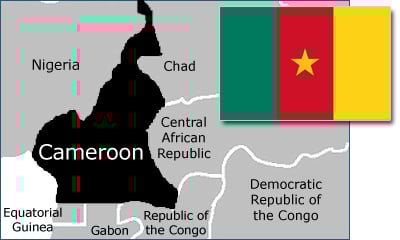
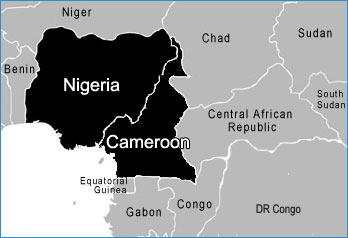
Located in West Africa, Cameroon was a German colony from 1884 until the end of WWI, when the territory was divided between France and the UK. Following French Cameroon’s independence in 1960, the southern portion of British Cameroon voted to merge with the new country the following year. Then, in 1972, a new constitution replaced the previous federation, and the country became the United Republic of Cameroon.
The constitution establishes the state as secular, prohibits religious harassment, and provides for freedom of religion and worship. Most of Cameroon has a thriving Christian presence and many churches. However, Christians living along the Nigerian border have experienced repeated attacks by Boko Haram.
Country Information
Population 30,966,105 (2024 est.)
Ethnicity Bamileke-Bamu, Biu-Mandara, Arab-Choa/Hausa/Kanuri, Beti/Bassa, Mbam, and others
Religions (%) Roman Catholic (33.1), Muslim (30.6), Protestant (27.1), other Christian (6.1), Animist (1.3), Other (0.7), None (1.2) (2022 est.)
Government type Presidential Republic
Leader President Paul Biya
Legal system Mixed system of English common law, French civil law, and customary law
Source: CIA World Factbook
Pray for Cameroon
Pray for greatly needed comfort and healing on behalf of Christian families who have lost loved ones due to devastating attacks by Boko Haram. Ask the Lord to provide strength, wisdom and encouragement to ministry workers who are serving the spiritual and emotional needs of those displaced. Intercede for members of Boko Haram – praying that they would come to recognize the brokenness of their lives and turn to faith in Christ. Furthermore, pray for the safety of Bible distributors working in dangerous regions, and for ongoing translation efforts to make God’s Word available in Cameroon’s many local languages.
As the West African nation of Cameroon faces conflict on two fronts, Christians are finding themselves trapped in the middle.
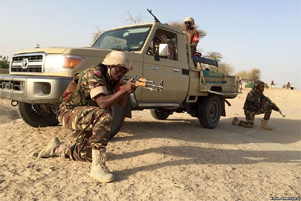
In northern Cameroon, the government has been fighting to stop the insurgence of Boko Haram terrorists who are moving south from Nigeria. In the process, members of the notorious group were raiding and pillaging villages throughout the area, forcing many Christians to flee for their lives. Numerous reports have been heard of pastors being attacked and killed by the militant Islamic group. Issues with Boko Haram also affect other neighbouring countries, including Chad and Niger.
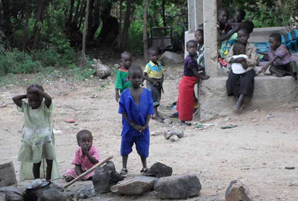
Internally displaced children in Cameroon's Far North Region. Photo: World Watch Monitor
Residents of Roum village, in the Far North Region of Cameroon, were abruptly awoken on the night of January 16th as blazing fires engulfed two churches and numerous homes in their village community. Boko Haram militants, who had stormed the village late that night, has claimed responsibility for the attack, in which four villagers were killed.
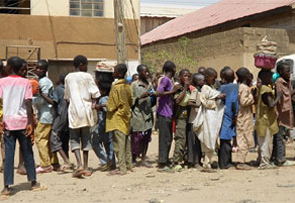
Boko Haram has used children as suicide bombers in northeast Nigeria. Photo: World Watch Monitor
After a period of relative calm, the Far North region of Cameroon, along the Nigerian border, has witnessed an upsurge of attacks by Boko Haram. On August 17th, a church elder was killed in a night raid carried out by the militant Islamic group on Moskota village. Adamu Nguda, formerly a church elder in Mouldougwa, had been previously displaced to live as an "internally displaced person" in Moskota. Adamu's killers also kidnapped his six children -- who are between the ages of three and 15 -- leaving his wife behind in a state of total shock.
Two Christian brothers, Ushahemba and Sughter Kumashenge, were ambushed and killed by Fulani militants on Saturday, August 22nd. The incident occurred on their farm in Taraba state, lending to concerns that militants in Nigeria's middle belt -- consisting of Kaduna, Taraba, Benue and Nasarawa states -- are joining forces with jihadists for the specific purpose of driving out Christians.
Over the summer, the violent attacks had intensified throughout northern Nigeria and its neighbouring country of Cameroon, causing some Christians in affected areas to refrain from attending church. On Saturday, July 25th, a 12-year-old girl detonated a suicide bomb within a crowded area in Maroua, northern Cameroon, killing 20 people and injuring 79 others. The following Friday, July 31st, six people died and eleven were injured in a massive bomb explosion at a market in Maiduguri, Nigeria -- the traditional heartland of the Nigerian violence.
Churches in Cameroon are presently struggling to contain the influx of approximately 60,000 Nigerian refugees and thousands of internally displaced persons (IDPs). "The level of attendance has also fallen in various churches," explains Rev. Samuel Heteck, President of the Protestant Churches' Council in Northern Cameroon. "We have observed a lack of concentration among some worshippers during recent services as their ears remain attentive to any movement outside."
Nigerian President Muhammadu Buhari visited Cameroon at the end of July in order to bolster collaborative efforts against the notorious Boko Haram terrorist group. Fortunately, the Nigerian military reported on August 2nd that they had rescued 178 people, including 101 children, all of whom had been taken captive by Boko Haram in the Nigerian state of Borno. To learn more about persecution in Nigeria, click here.
In the aftermath of recent attacks, we ask the Lord to minister healing to all who were injured and provide comfort to those who are now mourning the loss of loved ones. May He also calm the violence in these affected regions and alleviate mounting fears. As religious and political leaders make difficult decisions in their efforts to resolve the country's crisis, pray for God to grant them wisdom and clear direction so that all those whom they govern may be able to live "peaceful and quiet lives in all godliness and holiness" (1 Timothy 2:2).